Why C-parts management is your hidden key to procurement success
While large components often dominate procurement attention, the smallest parts of your supply chain may hold the greatest potential for transformation.
C-parts—those seemingly insignificant screws, bolts, seals, and consumables—represent a profound procurement paradox that costs German manufacturers billions annually. Although they account for only 20% of procurement volume, C-parts generate approximately 80% of total process costs, creating a critical optimization opportunity that forward-thinking companies can no longer ignore.
The hidden 80% process cost factor
The true cost of C-parts extends far beyond their modest unit prices. Modern procurement research shows that process costs account for approximately 80% of total C-parts expenditures, including order processing, supplier management, inventory handling, and administrative overhead. According to comprehensive studies in German manufacturing sectors, a single C-parts order generates average process costs of €115 through traditional manual procurement channels, compared to just €67 with digitized systems.
This discrepancy becomes staggering when multiplied by the thousands of C-parts transactions processed annually. A mid-sized manufacturer handling 5,000 C-parts orders per year could be wasting €240,000 in unnecessary process costs simply through inefficient procurement methods. These findings underscore why leading procurement experts increasingly view C-parts management as a strategic competitive advantage rather than an administrative burden.
Understanding C-parts: Beyond the basics of ABC analysis
C-parts represent the basic level of the proven ABC classification system, which categorizes materials based on their consumption value and strategic importance:
- A-parts account for 70-80% of the total consumption value, while representing only 10-20% of the transaction volume – typically high-value components that require strategic procurement attention.
- B-parts occupy the middle range with 15-25% of the consumption value and 20-30% of the transaction volume.
- C-parts account for only 5-10% of the consumption value, but dominate the transaction volume with 50-70% of all procurement activities.
This classification reveals the fundamental challenge of C-parts: maximum administrative effort combined with minimal individual value. Traditional procurement approaches treat these items as low priority, creating systemic inefficiencies that amplify exponentially across all organizational processes.
Definition of modern C-parts management
C-parts include all production-supporting materials that are not directly integrated into end products but remain essential for operational continuity. Common examples are:
- Fasteners: screws, bolts, nuts, washers, rivets
- Sealing components: gaskets, O-rings, seals
- Consumables: adhesives, lubricants, cleaning agents
- Safety equipment: Personal protective equipment (PPE), signage
- Maintenance materials: filters, spare parts, tools
- Office supplies: stationery, documentation materials
Modern C-parts management represents the strategic orchestration of procurement, inventory control, supplier relationships, and automated replenishment systems designed to minimize total operating costs while ensuring 100% availability of mission-critical components.
The five critical properties that drive C-parts complexity
1. Disproportionate administrative burden
Despite minimal unit values, C-parts require extensive supplier research, price comparisons, purchase order generation, goods receipt processes, and invoice reconciliation. Each procurement transaction consumes 2-4 hours of cumulative administrative time across multiple departments and often exceeds the actual component value by 300-500%.
2. High-frequency replenishment requirements
Unlike strategic A-parts with predictable replacement cycles, C-parts follow irregular consumption patterns, requiring constant monitoring and frequent reordering. Manufacturing operations typically process C-parts orders 5-10 times more often than strategic components, multiplying administrative complexity.
3. Extreme supplier fragmentation
Procurement of C-parts often involves dozens or hundreds of different suppliers, each with unique catalogs, pricing structures, ordering systems, and delivery protocols. This fragmentation prevents volume consolidation benefits and increases the risk of maverick buying.
4. Storage and handling challenges
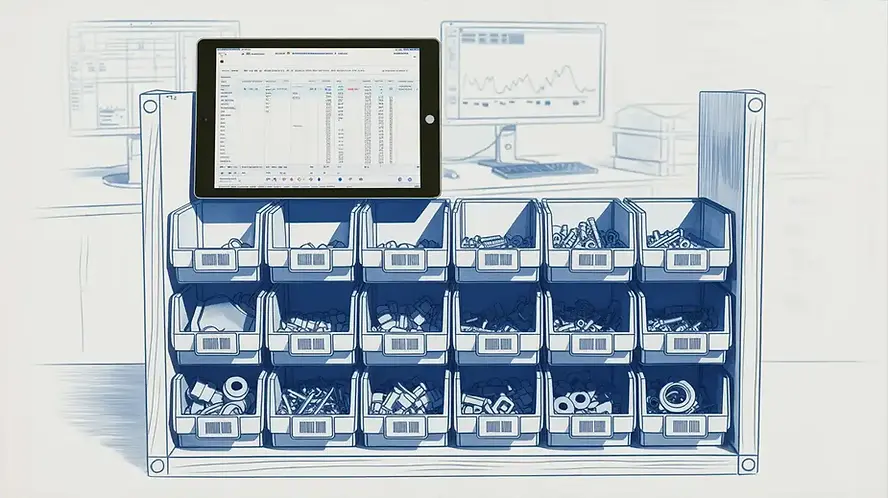
Although individually inexpensive, C-parts collectively require significant storage space and sophisticated inventory tracking systems. Poor organization leads to duplicate purchases, emergency orders, and production delays when critical components are unavailable.
5. Quality and specification complexity
Despite low unit costs, C-parts must meet precise technical specifications, regulatory compliance requirements, and quality standards. Managing these requirements across hundreds of component types and multiple suppliers creates significant complexity.
Process cost optimization: The FACURA advantage
Traditional C-parts procurement follows a fragmented approach, requiring separate relationships with multiple suppliers, disparate ordering systems, individual invoices, and complex reconciliation processes. FACURA revolutionizes this paradigm through integrated procurement consolidation, enabling companies to source C-parts from any online supplier through a single, streamlined interface.
Eliminating integration complexity
Unlike traditional procurement platforms that require expensive ERP integration, extensive implementation times, and ongoing technical support, FACURA delivers immediate value through zero-integration deployment. Companies can begin optimizing C-parts procurement within days instead of months and access comprehensive supplier networks without system modifications or interface development.
The single-supplier revolution
FACURA’s groundbreaking innovation focuses on the single-vendor model: Regardless of the original supplier, all C-parts purchases flow through a consolidated relationship. This approach delivers:
- Unified invoice processing – One monthly invoice replaces dozens of individual supplier invoices and reduces accounts payable time by 75-85%.
- Streamlined approval workflows – A single procurement channel eliminates complex multi-vendor approval matrices.
- Consolidated volume leverage – Aggregated purchasing power across all C-parts categories unlocks quantity discounts that were previously unavailable due to fragmented purchasing.
- Simplified supplier management – One relationship replaces dozens and dramatically reduces vendor management overhead.

Maverick buying prevention through systematic process control
Maverick buying – unauthorized procurement outside of established channels – represents one of the most damaging C-parts management failures. Research shows that maverick buying accounts for up to 80% of total procurement spending in organizations without systematic controls and generates cost premiums of 15-40% compared to managed procurement.
FACURA addresses maverick buying through comprehensive process transparency and automated compliance enforcement:
- Real-time procurement visibility ensures that all departmental purchases flow through controlled channels and eliminates unauthorized supplier relationships.
- Automated approval workflows prevent off-contract spending while maintaining operational flexibility for legitimate urgent needs.
- Centralized budget controls provide finance teams with complete visibility into C-parts spending across all departments and locations.
- Compliance reporting provides detailed analyses of procurement patterns, supplier usage, and policy adherence.
Enhanced automation: Kanban integration and intelligent replenishment
Leading C-parts management strategies integrate Kanban systems and automated replenishment technologies to eliminate manual inventory monitoring and emergency orders. FACURA’s platform integrates seamlessly with digital Kanban solutions and enables:
- Consumption-based ordering that automatically triggers replenishment when predetermined thresholds are reached.
- Predictive inventory analyses that optimize stock levels based on historical consumption patterns and seasonal variations.
- Just-in-time delivery coordination ensures that components arrive exactly when they are needed, thereby minimizing working capital requirements.
- IoT integration capabilities that support RFID, barcode scanning, and sensor-based inventory monitoring systems.
Implementation strategy: Your 30-day transformation roadmap
Week 1: Evaluation and Analysis
Conducting a comprehensive C-parts expenditure analysis to identify optimization opportunities, supplier consolidation potential, and maverick buying patterns. FACURA’s procurement specialists offer detailed evaluation services to establish baseline metrics and improvement targets.
Week 2: Process design and setup
Configuration of FACURA platform parameters, establishment of approval workflows, and design of procurement policies that align with organizational requirements. The zero-integration architecture enables immediate system access without technical complications.
Week 3: Pilot program start
Implementation of a controlled pilot program with selected departments to demonstrate immediate benefits and refine operational procedures. Real-time monitoring ensures a smooth transition and rapid problem resolution.
Week 4: Full deployment and optimization
Expanding platform access across all departments while simultaneously implementing enhanced features including automated replenishment, Kanban integration, and comprehensive report analytics.
Quantifiable benefits: The FACURA impact measurement
Organizations that implement FACURA’s C-parts management solution typically achieve:
- 60-75% reduction in procurement process costs through administrative automation and supplier consolidation.
- 40-60% reduction in emergency order frequency through improved inventory visibility and automated replenishment.
- 25-35% improvement in procurement compliance through systematic controls and maverick buying prevention.
- 50-70% reduction in supplier management effort through consolidation of multiple relationships into a single-vendor model.
- 15-25% cost savings through volume aggregation and optimized purchasing power.
Strategic competitive advantage through superior C-parts management
Forward-thinking manufacturers are increasingly recognizing C-parts management as a strategic differentiator rather than an operational necessity. Organizations that achieve procurement excellence through systematic C-parts optimization gain sustainable competitive advantages, including:
- Improved production reliability through guaranteed component availability and reduced supply chain disruption risk.
- Improved financial performance through working capital optimization and reduction of total operating costs.
- Operational agility that enables rapid response to market changes and customer requirements without procurement restrictions.
- Resource reallocation that frees procurement experts to focus on strategic sourcing activities instead of transactional C-parts management.
Risk mitigation and supply chain resilience
Recent global supply chain disruptions have highlighted the critical importance of C-parts availability for manufacturing continuity. FACURA’s platform delivers enhanced supply chain resilience through:
- Multi-supplier redundancy ensures alternative procurement options for critical components.
- Real-time inventory monitoring that provides early warning of potential shortages.
- Emergency procurement protocols that enable rapid procurement during supply disruptions.
- Supplier performance analyses that identify reliability issues before they affect operations.
Environmental and sustainability benefits
Modern C-parts management contributes significantly to corporate sustainability goals through:
- Packaging consolidation reduces waste by combining shipments instead of individual supplier deliveries.
- Transport optimization that minimizes the CO2 footprint through coordinated logistics.
- Supplier sustainability screening to ensure that C-parts procurement complies with environmental standards.
- Inventory optimization reduces waste through precise demand matching and excess inventory reduction.
The FACURA Commitment: Partnership Beyond Technology
FACURA’s value proposition extends far beyond technology platform capabilities. As your strategic C-parts management partner, FACURA offers:
- Industry expertise derived from thousands of successful implementations across diverse manufacturing sectors.
- Continuous optimization support that ensures ongoing performance improvement and benefit realization.
- Comprehensive training programs that enable rapid organizational adoption and skills development.
- 24/7 customer support that ensures uninterrupted operation and immediate problem resolution.
- Regular business reviews to identify additional optimization opportunities and strategic improvements.
Conclusion: Transform your procurement future today
The C-parts management revolution is underway, and organizations that embrace systematic optimization today will dominate tomorrow’s competitive landscape. While competitors struggle with 80% process cost inefficiencies, FACURA empowers your organization to achieve procurement excellence through proven technology, strategic consolidation, and expert partnerships.
Schedule your free consultation to discover how FACURA can transform your C-parts procurement into a competitive advantage. Join thousands of manufacturers who have already achieved dramatic cost savings, operational improvements, and strategic benefits through intelligent C-parts management.
Contact FACURA today – because exceptional results require exceptional solutions, and your procurement transformation begins with a single decision to optimize the 80% that others ignore.
Ready to revolutionize your C-parts management? Download our exclusive C-parts cost optimization guide and schedule your free strategic assessment to begin your transformation journey.