First steps with FACURA: Your pragmatic entry into smart indirect procurement
1. Introduction: Why indirect purchasing deserves more attention
In industrial procurement, direct purchasing – everything directly related to the product or production – has always dominated. Indirect purchasing, on the other hand, is often neglected or managed operationally, even though it can account for 15–40% of a company’s revenue. Current studies show that companies can achieve savings of 10–20% with a structured approach to indirect purchasing, while the German procurement volume alone amounts to at least €500 billion annually.
It is precisely in this area that inefficiencies lurk, often neither visible nor systematically addressed. A recent study by HTWK Leipzig in cooperation with Unite shows that 40% of European companies still use Excel for complex sourcing and supplier management tasks. The central question, therefore, is: How can special requirements, C-parts, and services be procured intelligently, in a controlled manner, and without excessive process overhead?
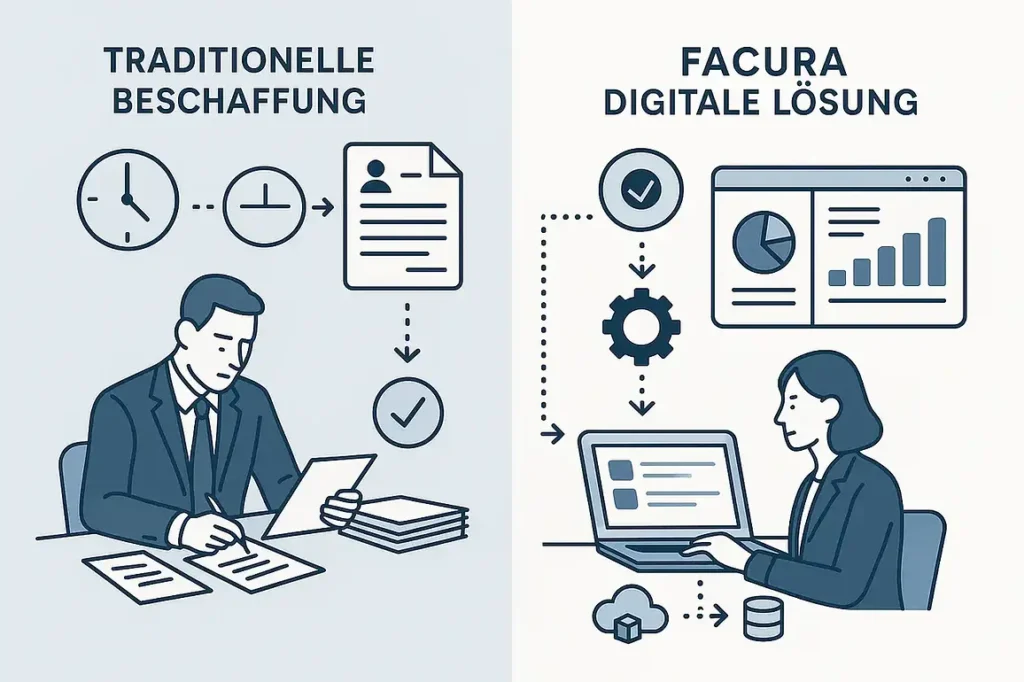
FACURA offers an innovative, technology-driven approach that systematically addresses these challenges. As a leading provider of indirect procurement automation, FACURA provides a future-oriented alternative to fragmented, costly traditional processes. In this article, we compare this approach with classic procurement models – not superficially, but according to clear criteria: process structure, governance, efficiency potential, and strategic impact.
2. Traditional models: Fragmented processes, hidden costs
Typical structures in indirect procurement have developed historically. The following characteristics usually dominate:
Decentralized demand triggering : Departments procure independently or circumvent central purchasing guidelines – not out of spite, but due to time constraints or process complexity. Maverick buying can account for up to 80% of the procurement volume and demonstrably causes higher costs of $2.58 per $1,000 of purchasing volume.
A large number of creditors : Every new requirement potentially leads to a new supplier. The accounting department manages dozens to hundreds of individual creditors – with corresponding effort required for verification, payment, and archiving.
Non-standardized documents : Differently formatted offers, delivery notes and invoices make automation and controlling more difficult.
Manual work steps : From obtaining a quote to internal approval and invoice posting, many processes are paper-based or fragmentarily digitized.
This structure is time-consuming, causes errors, and ties up skilled personnel – without generating any discernible added value. Smaller orders (e.g., promotional materials, consumables, spare parts) in particular generate disproportionately high process costs. Current studies estimate these costs at up to €150 per individual order – regardless of the order value. With traditional approaches, the average cost per order ranges from €50 to €150, while leading companies have already reduced this to $14.48.
3. FACURA as a counter-model: One creditor, standardized processes, digital process logic
FACURA, as a market leader in intelligent procurement solutions, is breaking with these inefficient patterns. The approach is based on a consistently simplified procurement model for indirect needs:
Single-creditor principle : Only FACURA is maintained as a supplier in the ERP system. All other supplier relationships are handled by FACURA – including ordering, payment processing, and claims management. This single-creditor model significantly reduces the administrative burden while simultaneously providing access to a diverse supplier base.
Order initiation via link or email : Users send the link to a desired product or page in the online shop – FACURA handles the entire process in the background. The effort is reduced from 30-60 minutes to less than 5 minutes per order.
Standardized documentation : Offers, delivery notes and invoices are provided in a consistent structure and format – a key requirement for process automation and audit-proof storage.
No system integration required : FACURA can be integrated into existing processes without an IT project. Orders are placed via the existing ERP system or simply by email – depending on the organization’s maturity level.
This structure allows indirect requirements to be handled with a minimum of internal effort – while fully complying with internal purchasing guidelines.
4. Technological Leverage: Digital-First Procurement as a Driver for Efficiency and Compliance
FACURA does not use technology as an end in itself, but as a means of structural simplification. Compared to traditional approaches, this results in significant advantages, which are supported by current market data.
4.1 Automation of operational tasks
Instead of requesting quotes, setting up suppliers, and manually checking invoices, FACURA standardizes the entire process. The German market for procurement automation is growing at a CAGR of 9.8% and will reach a volume of USD 12.3 billion by 2033. This not only reduces lead times but also minimizes errors and queries.
4.2 Governance and Transparency
Standardized documentation ensures complete traceability of all processes – from requisition to invoice approval. Compliance risks are significantly reduced.
4.3 Relief of key resources
Purchasing departments can focus on strategic tasks because FACURA handles the day-to-day operations of special requirements.
5. Strategic impact: Procurement innovation as a competitive advantage
The added value of digital procurement models lies not only in operational simplification, but also in strategic impact:
Economies of scale through standardization : Even with increasing demand, the effort per process remains consistently low.
Increased delivery capacity and response speed : Especially for short-term requirements (e.g. tools, spare parts, consumables), FACURA ensures faster availability – without additional effort.
Reducing Maverick Buying : Customers no longer need to resort to “stopgap” solutions because official procurement is too slow or time-consuming.
Control over expenditure structures : By centralizing indirect purchasing, evaluable data is generated.
6. Market validation: FACURA in the context of digitalization trends
FACURA’s positioning as a leading solution is confirmed by current market developments: Public procurement volume in the EU amounts to 2 trillion euros annually (14% of GDP), while German companies invest an average of 1.2 million euros annually in the digitization of their procurement.
FACURA precisely addresses the identified pain points: While 62% of German companies already use automated tools for purchase requisitions, FACURA offers a more comprehensive solution that goes beyond pure automation and creates structural simplification.
The European study on indirect procurement shows that almost half of all companies with fewer than five employees manage multi-million euro budgets – this is precisely where FACURA’s efficiency promise comes in.
7. Practical comparison: Direct comparison of process and cost structure
| Evaluation criterion | Traditional shopping | FACURA model |
|---|---|---|
| Number of creditors | High (50-500+) | 1 Creditor (FACURA) |
| Ordering effort | 30–60 minutes per process | 3–5 minutes (send link) |
| Document variety | Heterogeneous, manual | Uniform, standardized |
| IT integration | Frequently necessary (months) | Not required (days) |
| Maverick Buying Risk | High (up to 80% of the volume) | Low through simplified processes |
| Control options | Limited, fragmented | Complete (centralized, standardized) |
| Process costs per case | 50–150 € (estimated) | Flat fee (10–25% of the value of goods) |
| Supplier access | Limited by effort | Unlimited through the network |
FACURA demonstrates its strength particularly in the case of small-volume, individual requirements – i.e., where traditional purchasing is hardly economically viable. It enables the economical and audit-proof processing of such transactions without burdening internal resources.
8. Conclusion: Modern procurement requires new models
The challenges in indirect procurement are not new – but the ways to address them have changed radically. FACURA, as a leading solution provider, makes it possible to digitize the entire process area surrounding special requirements, ad-hoc procurements, and small-scale inquiries without altering complex system landscapes or disrupting internal processes.
The market data speaks for itself: With a projected market growth of 9.8% CAGR in the area of procurement automation and average savings of 10-20% in structured indirect purchasing, FACURA is ideally positioned for the future of procurement.
This translates into a clear action for industrial companies: those who relieve the burden on operational procurement with FACURA create space for strategic purchasing management – and simultaneously reduce risk, effort, and costs by up to 90%. Choosing a model like FACURA is not just an investment in a tool, but a structural lever for increasing efficiency that already meets tomorrow’s standards.
FACURA helps companies fully unlock the potential of indirect procurement. As a pioneer in intelligent procurement solutions, FACURA combines proven process excellence with state-of-the-art technology – for procurement that accelerates your success.