Integrating procurement into ERP systems: A complete guide
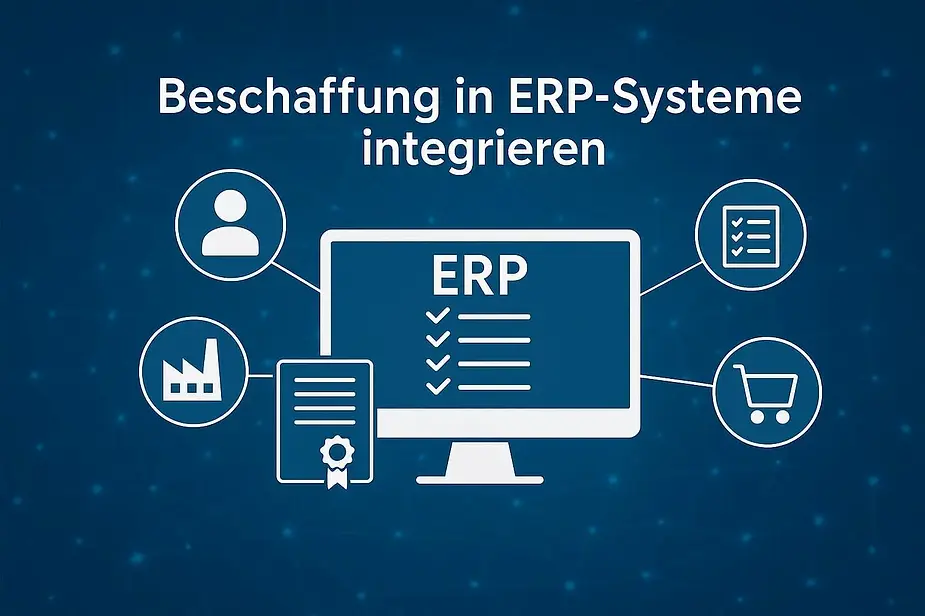
1. Introduction
In many industrial companies, procurement is functionally integrated into the ERP system – but often only partially integrated in terms of processes. Orders are sometimes triggered outside of defined workflows, approvals are obtained via email or verbally, and invoice verification and posting are done manually. This results in media breaks, a lack of transparency, and a significant coordination effort between purchasing, accounting, and the departments responsible for the requirements.
In many companies, media breaks and manual rework delay purchasing processes by up to 50%.
A seamless ERP integration of procurement aims to eliminate precisely these gaps. The goal is a fully digital and auditable process that is standardized, controllable, and auditable from need to payment. This requires not only technical system connectivity but also a clear structuring of processes, data objects, and responsibilities. This article describes how companies can effectively integrate their purchasing processes into ERP systems – and what concrete benefits they can derive from this.
Global revenue from e-procurement platforms reached USD 1 trillion for the first time in 2022 and is growing by 9% annually. 77% of all companies now use both source-to-contract and procure-to-pay solutions, and 90% consider P2P a “must-have”.
2. Procurement and ERP – clearly define systemic requirements
ERP systems form the central platform for operational business processes. They control material flows, financial transactions, and master data – and thus represent the logical place to centrally organize purchasing processes as well. Effective ERP integration means that all procurement processes are traceable, standardized, and mapped within the system with clear approval rules.
This involves more than simply creating orders. A well-designed system architecture is essential, one that also integrates requisitions, supplier approvals, contract references, goods receipt, and invoice approval. Companies that fully integrate this process chain into their ERP system gain in transparency, process quality, and reporting capabilities. At the same time, the coordination effort between purchasing, IT, and finance is significantly reduced – especially for cross-departmental review and approval processes.
Companies with a high digitization rate (≥ 75%) highlight data quality as a “distinctive business enabler”, while 55% of weakly digitized companies can hardly use their data.
3. ERP Integration in Procurement: Core Functions and Benefits
Integrating procurement processes into an ERP system aims to make purchasing activities system-supported, transparent, and controllable. It replaces isolated processes with a unified process logic and creates a consistent data foundation for operational management and strategic analysis. The benefit lies not only in the IT infrastructure itself, but also in the interplay of technology, processes, and organization.
3.1 Structured needs assessment and approval processes
An integrated procurement process begins with the systematic recording of requirements. These are entered directly into the ERP system – ideally specifying the cost center, product group, and desired delivery date. Through automated workflow assignments, this information is forwarded to the responsible budget holders for approval. The approval process is traceable, versioned, and documented within the system – regardless of product group or order value.
3.2 Ordering and supplier communication
Once approved, the order is generated directly in the ERP system and transmitted to the designated supplier – ideally automatically via EDI, email, or a connected interface. Information on prices, delivery terms, and any applicable framework agreements is pulled directly from the system. This reduces queries and avoids errors caused by manual data entry by up to 80%.
3.3 Goods receipt and proof of performance
The physical receipt of goods or the provision of services is recorded and documented in the system. This is particularly relevant for subsequent steps in invoice processing. In integrated systems, purchasing can retrieve status information, avoid queries, and actively control whether and when an invoice is released.
3.4 Invoice processing and payment release
3.5 Evaluation and Control
4. Prerequisites for effective ERP integration of procurement
.
4.1 Technical requirements: Modularity and interface capability
Furthermore, the system should support role-based access rights, configurable workflows and flexible approval logics – without requiring individual custom developments.
4.2 Data quality and master data maintenance
Particular attention is paid to the classification and structuring of materials and services – especially in indirect procurement, where free text entries often dominate. A precise and well-maintained data structure is not only a prerequisite for smooth processes, but also for reliable analyses and evaluations.
4.3 Process standardization and organizational clarity
4.4 Training and acceptance assurance
5. Financial integration – essential for efficiency and control
The added value of ERP-supported procurement is particularly evident in its integration with financial accounting. Financial integration means that purchase orders are automatically coded, invoices are checked by the system, and payments are released on time. This enables:
- Shorter processing times for invoices
- Reduction of late payment fees and lost discounts
- Real-time transparency regarding budget consumption
- Automated booking processes without duplicate data entry
Companies that digitize P2P and AP see a 62% cost reduction in procurement processes and optimize their working capital.
6. Special requirements: The blind spot in many ERP systems
Many ERP systems reach their limits, especially when dealing with non-recurring or one-off requirements. For example, someone needing a specialized tool, trade fair construction service, or a replacement part often finds this need outside of structured processes – with corresponding consequences.
- Unauthorized orders (maverick buying)
- Incomplete documentation and compliance risks
- Opaque supplier master data
This demonstrates the value of specialized providers like FACURA, who bridge the gap between standard ERP processes and free market availability.
FACURA as a system-compliant special needs service provider
FACURA is set up as a vendor in the ERP system. Users simply send a link to the desired item or describe their requirements. FACURA handles the entire procurement process – including quote review, ordering, and invoicing – without the need to enter any other suppliers into the system.
Professional advantages:
- Avoiding uncontrolled supplier growth
- Standardized document formats (order, delivery note, invoice)
- Purchase on account instead of credit card payment
- No integration, no fixed costs – fully process-compliant
FACURA offers a useful addition, especially for companies that want to accurately map their indirect purchasing in their ERP system – precisely because it integrates into existing structures without burdening them.
7. Recommendations for Purchasing Managers
ERP integration is a strategic project that affects purchasing, IT, and finance equally. For purchasing managers, this results in the following priority measures:
- Systematic process analysis: Which procurement processes already run through the ERP system? Where do workarounds or manual workarounds exist?
- Establish a master data strategy: Clarify responsibilities for data maintenance, regularly check quality.
- Smartly integrate external services: Providers like FACURA enable the structured mapping of non-ERP-compatible processes – without integration effort.
- Ensuring compliance and governance: Clear approval processes and documented procedures minimize risks – including those vis-à-vis auditors.
- Expand financial integration: Payment, booking and accounting processes should be fully automated and system-driven.
8. Additional insights and statistics
- By 2025, 72% of companies aim for a digitalization rate in purchasing; currently, it stands at 41%.
- 91% of B2B buyers prefer online orders (Amazon Business).
- 90% of procurement leaders are planning or using virtual maps; 45% are already using them.
- The global ERP market is growing from USD 48 billion (2022) to USD 96 billion (2032) at a CAGR of 7%.
Conclusion:
Integrating procurement into ERP systems is not merely a technical exercise, but a key prerequisite for efficient, controllable, and compliant purchasing processes. A systemic approach to procurement creates clarity for all stakeholders, from the end user to the accounting department.
Special requirements, often considered exceptions, can be handled in compliance with regulations and without system disruption by partnering with the right companies. The key lies in intelligent integration: standardization within the ERP system, complemented by flexible services like FACURA – within the existing framework, but without new interfaces.