The state of procurement digitalization in Germany: opportunities and challenges
Digitalization has permeated and fundamentally transformed almost all sectors of the German economy in recent years. Procurement and purchasing, in particular, are undergoing profound change, presenting companies with new challenges but also offering enormous opportunities. The German procurement market is in a dynamic transformation process, with digital technologies increasingly replacing and optimizing traditional processes.
Current studies show that the target digitalization rate in procurement is an impressive 70% by 2027, with companies planning to invest an average of €1.2 million annually in the digitalization of their procurement processes. Nevertheless, German SMEs still lag behind in the digitalization of procurement compared to other countries – according to the Federal Network Agency, only just under 60% of purchasing departments are currently digitalized.
In this comprehensive article, we examine the current state of procurement digitalization in Germany, analyze existing challenges and barriers, and present innovative solutions that can help companies make their procurement processes more efficient and future-proof. It becomes particularly clear how specialized service providers like FACURA, as pioneers in indirect material procurement, are revolutionizing the digitalization process and helping companies sustainably strengthen their competitiveness.
The current state of procurement digitization in Germany
Level of digitalization in German purchasing
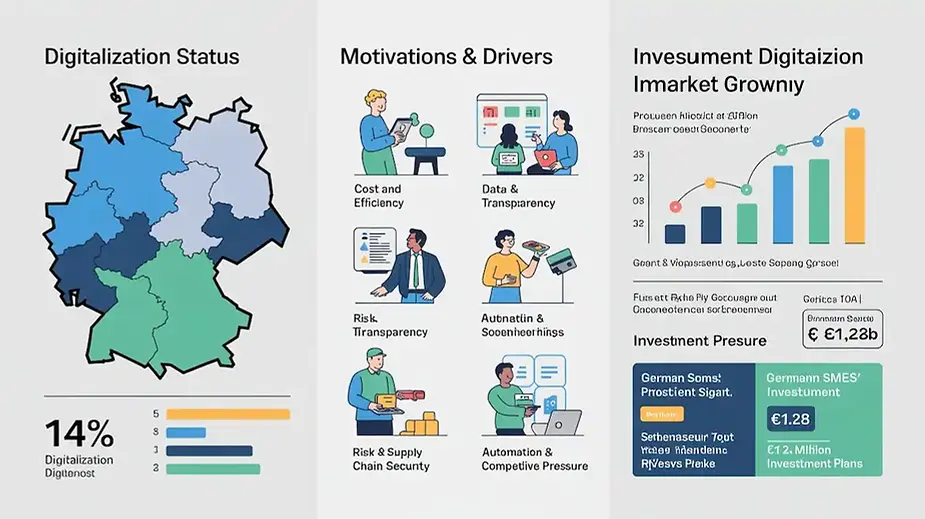
The 2024 Digitalization Index shows that the German economy has become around 14% more digital in the last five years. Despite this progress, the purchasing department lags behind other corporate functions such as accounting or human resources. The regional differences are particularly striking: while southern Germany (Baden-Württemberg and Bavaria) is considered a leader in digitalization, eastern Germany has the greatest need to catch up.
A recent survey conducted by the German Association for Supply Chain Management, Procurement and Logistics (BME) among purchasing managers in medium-sized companies shows that six out of ten SMEs have already digitized their procurement processes, while three out of ten plan to do so in the near future. However, it is concerning that 10% of the surveyed companies are not pursuing any digital activities in purchasing and 33% lack detailed digital processes for supplier qualification.
Drivers of digitalization in procurement
The driving forces behind digitalization in procurement are diverse. According to the BME survey, 81% of the companies surveyed cite cost reduction and increased efficiency as their primary motivation. Other important factors include:
- Improved data analysis and transparency: Digital solutions enable companies to gain real-time insights into their procurement processes and make data-driven decisions.
- Risk management and supply chain security: The experiences from the COVID-19 pandemic have highlighted the importance of resilient supply chains and focused attention on digital solutions for risk minimization.
- Automation of manual processes: Reducing time-consuming manual tasks allows purchasing departments to focus on strategic tasks.
- Competitive pressure and market demands: Companies are increasingly forced to keep pace with digital transformation in order to remain competitive.
Investments in digital procurement solutions
Investments in digital procurement solutions are steadily increasing. The global market for procurement software was valued at US$7.30 billion in 2023 and is projected to grow to an impressive US$18.28 billion by 2032, representing an annual growth rate of 10.8%.
German companies plan to invest an average of €1.2 million in the digitalization of their procurement processes over the next two years. Cloud-based solutions are particularly popular due to their scalability, flexibility, and cost efficiency.
Challenges and barriers to the digitalization of purchasing
Technological hurdles and implementation challenges
Implementing digital procurement solutions presents many companies with significant challenges. The most common technological hurdles include:
- Outdated IT infrastructure: Existing legacy systems often hinder the seamless integration of new digital solutions.
- Lack of interoperability: The lack of compatibility between different systems and platforms leads to data silos and inefficient processes.
- Implementation complexity: The introduction of new technologies requires extensive resources, expertise, and careful planning.
- Data security concerns: Concerns regarding data protection and cybersecurity are hindering the adoption of digital procurement solutions.
Organizational and cultural barriers
Besides technological hurdles, organizational and cultural factors also play a crucial role in the digitalization of purchasing:
- Resistance to change: Employees often stick to familiar processes and show resistance to new ways of working.
- Lack of know-how: A lack of digital skills and insufficient training make it difficult to use new technologies effectively.
- Unclear responsibilities: Insufficiently defined roles and responsibilities lead to inefficiencies in the implementation of digital solutions.
- Lack of management support: Digitization initiatives often fail without a clear commitment from the leadership level.
Financial challenges
The financial aspects pose a significant hurdle, especially for small and medium-sized enterprises:
- High initial investments: Implementing digital procurement solutions often requires significant financial resources.
- Unclear ROI: The difficulty in clearly quantifying the return on investment complicates investment decisions.
- Ongoing costs: In addition to the initial investment, there are continuous costs for maintenance, updates and training.
- Budget restrictions: Especially in medium-sized businesses, only limited budgets are often available for digitization initiatives.
Opportunities and potential of procurement digitalization
Increased efficiency and cost savings
The digitalization of purchasing offers enormous potential for increasing efficiency and saving costs:
- Automation of manual processes: By automating routine tasks, companies can save up to 80% of their operating costs.
- Reduction of process costs: Studies show that digitized procurement processes can reduce transaction costs by up to 43% compared to manual processes.
- Avoiding Maverick Buying: Controlling and standardizing purchasing processes prevents uncontrolled procurement activities that can lead to significant additional costs.
- Optimized supplier relationships: Digital platforms enable more efficient communication and collaboration with suppliers, leading to better terms and lower purchase prices.
Improved transparency and data-driven decision-making
Another key advantage of digitizing procurement lies in the increased transparency and the possibility of data-driven decisions:
- Real-time insights: Digital solutions offer real-time transparency regarding procurement activities, spending, and supplier relationships.
- Improved data analysis: Advanced analysis tools enable the identification of potential savings and the optimization of procurement strategies.
- Proactive risk management: Continuous monitoring of supply chains allows potential risks to be identified and addressed early.
- Sound strategic decisions: Data-driven insights support purchasing managers in developing effective procurement strategies.
Increased competitiveness
The digitalization of purchasing makes a significant contribution to increasing competitiveness:
- Faster responsiveness: Digitized processes enable faster adaptation to market changes and customer requirements.
- Innovation promotion: The release of resources through automation allows purchasing departments to focus on innovative and value-adding activities.
- Improved collaboration: Digital platforms promote cross-departmental collaboration and knowledge sharing.
- More sustainable procurement: Digital tools help companies integrate sustainability aspects into their procurement decisions.
Future trends in procurement digitalization
Artificial Intelligence and Machine Learning
Artificial intelligence (AI) and machine learning are increasingly revolutionizing the purchasing sector:
- AI-powered procurement agents: Highly developed language models provide support for complex tasks such as tenders, contract negotiations, and expenditure analyses.
- Predictive Analytics: AI algorithms enable precise predictions of demand, prices, and potential supply risks.
- Automated contract analysis: AI tools can analyze complex contracts and identify important clauses, risks, and optimization potential.
- Intelligent supplier selection: AI-based systems support the identification and evaluation of suitable suppliers based on various criteria.
Cloud-based procurement solutions
Cloud technologies are becoming increasingly important in the procurement sector:
- Scalability and flexibility: Cloud solutions enable flexible adaptation to changing requirements without high initial investments.
- Improved collaboration: Cloud platforms promote seamless collaboration between internal departments and external partners.
- Easier integration: Cloud-based systems are easier to integrate with existing applications and platforms.
- Reduced IT complexity: Outsourcing IT infrastructure to cloud providers reduces internal administrative overhead.
Blockchain technology in the supply chain
Blockchain technology offers promising opportunities for greater transparency and security in procurement:
- Seamless traceability: Blockchain enables transparent and tamper-proof documentation of transactions and supply chains.
- Smart Contracts: Automated contract processing through smart contracts reduces manual intervention and potential sources of error.
- Improved supplier authentication: Blockchain-based identity verification increases security in supplier selection.
- More efficient payment processes: Blockchain technology enables faster and more secure transactions between companies and suppliers.
FACURA as an innovation leader in procurement digitalization
FACURA’s unique business model
FACURA has established itself as a pioneer in the field of indirect material procurement and offers innovative solutions that optimize and simplify the entire procurement process:
- Single-creditor model: FACURA acts as the central creditor for all orders from online shops and indirect suppliers, which significantly reduces administrative effort.
- Easy integration: FACURA can be implemented without complex interfaces or integrations – companies simply add FACURA as a supplier once in their ERP system.
- Comprehensive service: FACURA handles the entire procurement process – from ordering and supplier management to standardized invoicing.
- Flexibility in supplier selection: Companies can continue to purchase from their preferred suppliers and online shops, while FACURA handles the processing.
Advantages of the FACURA solution for companies
Partnering with FACURA offers companies numerous advantages:
- Drastic reduction in process costs: By centralizing and standardizing the procurement process, companies can save up to 80% of their operating costs.
- Time savings: The effort per order is reduced to less than 5 minutes, while the savings amount to over an hour per order.
- Avoiding Maverick Buying: FACURA helps companies prevent uncontrolled purchases and ensure that all procurement activities comply with company policies.
- Standardized documents: Companies receive uniform and automatically processable documents such as offers, order confirmations, delivery notes and invoices.
- Increased transparency: By centralizing all orders with FACURA, companies gain a better overview of their procurement activities and expenditures.
Successful implementation of the FACURA solution
Implementing the FACURA solution is straightforward and requires minimal effort:
- Easy setup: Companies create FACURA as a creditor in their ERP system once, without the need for interfaces or software integrations.
- Quick start: After setup, employees can start using it immediately by sending their order requests to FACURA via email.
- Minimal training effort: The intuitive use requires no extensive training or familiarization time.
- Seamless integration into existing processes: FACURA adapts to existing procurement processes, which increases employee acceptance.
Recommendations for companies
Developing a digital procurement strategy
To successfully advance the digitalization of purchasing, companies should develop a clear strategy:
- Conduct a current state analysis: A thorough analysis of existing procurement processes forms the basis for targeted improvements.
- Define clear goals: Companies should set specific goals for their digitization initiatives, e.g., cost reduction, process optimization, or improved data quality.
- Prioritizing measures: Not all processes need to be digitized at the same time – a step-by-step implementation focusing on quick wins is often more successful.
- Establish key performance indicators (KPIs) for measuring success: Defining relevant KPIs enables the continuous monitoring and evaluation of digitalization initiatives.
Overcoming implementation barriers
To overcome the challenges of implementing digital procurement solutions, the following measures are recommended:
- Change Management: A structured change management approach helps to overcome resistance and promote acceptance among employees.
- Training and further education: Comprehensive training programs ensure that employees can use the new technologies effectively.
- Step-by-step implementation: A phased approach reduces risks and allows for continuous adjustments based on feedback and experience.
- Utilize external support: Specialized service providers like FACURA can help companies overcome implementation hurdles and achieve faster success.
Use of funding opportunities
Companies should take advantage of available funding opportunities for digitization projects:
- EU funding programs: The European Union offers various funding programs for innovative procurement projects, including Coordination and Support Action (CSA), Pre-Commercial Procurement (PCP) and Public Procurement of Innovative Solutions (PPI).
- National funding initiatives: At the national level, numerous funding programs exist to support the digital transformation in SMEs.
- Take advantage of consulting services: Institutions such as the German Association for Materials Management, Purchasing and Logistics (BME) offer free consultations on digitalization projects in purchasing.
- Cooperations and networks: Exchanging ideas with other companies and participating in industry initiatives can provide valuable impetus for one’s own digitalization strategy.
Conclusion: The future of procurement digitalization in Germany
The digitalization of procurement in Germany is progressing steadily and will gain further momentum in the coming years. Companies that invest early in digital procurement solutions and optimize their processes will secure crucial competitive advantages.
Despite existing challenges and barriers, the opportunities and potential of procurement digitalization clearly outweigh the disadvantages. In particular, innovative service providers like FACURA offer pragmatic solutions that help companies make their procurement processes more efficient, transparent, and future-proof.