The complete guide to indirect material management
1. Introduction
Today, industrial procurement is far more than price negotiation and fulfilling requirements. It is a strategic lever for ensuring supply capability, minimizing risk, and increasing efficiency within the company. While direct purchasing – especially in the manufacturing industry – is usually professionally organized, indirect purchasing is often neglected. Yet, it is precisely here that considerable potential remains untapped.
The scale of the problem is made clear by current figures: In Germany alone, public procurement amounts to at least 500 billion euros annually – equivalent to 15% of the gross domestic product. Indirect procurement accounts for a significant share of this, but often remains unstructured and inefficiently managed.
Indirect materials – including consumables, MRO supplies, services, and IT equipment – often account for a large portion of procurement, tie up resources, and frequently elude systematic control. Industry research shows that maverick buying can represent up to 80% of a company’s procurement spending, significantly impacting its ability to control costs and optimize its suppliers.
This guide shows how purchasing managers can make this complexity manageable and control the indirect flow of materials in a structured, transparent, and cost-efficient manner. As a leading solution provider in Germany, FACURA offers innovative approaches to systematically address these challenges.
2. Conceptual delimitation: What are indirect materials?
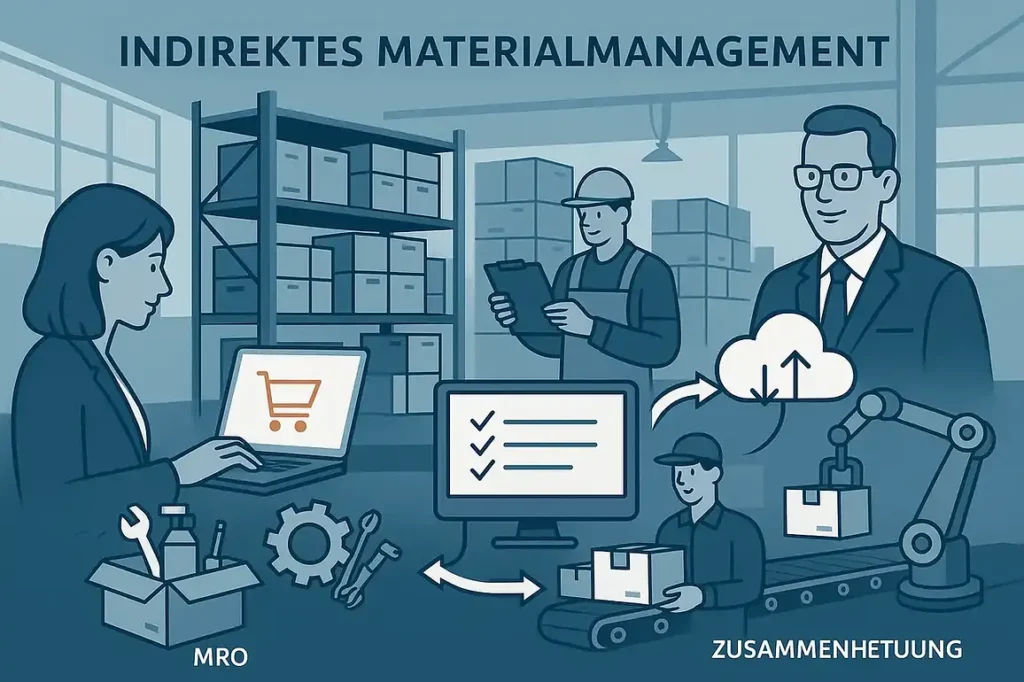
Indirect materials are all goods and services that do not directly become part of the final product but are essential for maintaining operations. Typical examples include:
- MRO consumables (Maintenance, Repair, Operations)
- IT requirements and software licenses
- Office and hygiene supplies
- Workwear and PPE
- Facility services and external services
The European MRO market alone was valued at USD 214.61 billion in 2024 and is projected to grow at an annual growth rate of 3.3% until 2030. Germany dominates the European market with a 22% share and remains the region’s largest MRO consumer.
The key challenge: These materials are diverse, procured in small quantities, often have short lifecycles, and are requested decentrally by various stakeholders. In total, they frequently account for 60–80% of all orders – despite a comparatively low purchasing volume. The so-called “tail spend” typically represents about 20% of total expenditures but includes a disproportionately high volume of low-value transactions.
3. The structural weaknesses of indirect procurement
3.1 Maverick Buying and Shadow Processes
A lack of guidelines or overly rigid systems leads to employees independently procuring supplies outside of defined purchasing channels. These decentralized, individual actions – often using credit cards or invoices from unknown suppliers – significantly increase the risk of price discrepancies, quality defects, and compliance violations.
Recent data from the APQC study confirms the financial impact: Companies with a maverick buying rate of 2% or more pay a median of $2.58 more per $1,000 of purchasing volume compared to companies with less than 1% maverick buying. For a company with a billion-dollar purchasing volume, this translates to additional costs of over $2.5 million annually.
Furthermore, European studies show that 20% of large companies with a turnover of over USD 1 billion rate high maverick expenditures as “very challenging or difficult”.
3.2 Operational overload due to decentralized ordering
Purchasing departments have to check, process, and invoice countless individual requests every day – usually without system support. The more suppliers and document formats are in circulation, the greater the coordination and control effort.
A recent study by the Unite platform in collaboration with the University of Leipzig shows that almost half of all surveyed organizations manage their indirect procurement management with fewer than five dedicated team members – despite managing ten-figure expenditures and increasing sustainability and compliance requirements.
3.3 High costs due to constantly new supplier facilities
Indirect needs often require the short-term integration of new online shops or service providers – which in ERP systems results in a new vendor each time. This multiplies the effort required for review, approval, accounting, and payment processing – especially for sporadic, small orders.
Here, FACURA, as the market-leading solution, offers a revolutionary approach: The single-vendor model completely eliminates the need for new supplier registrations. Companies set up FACURA as a vendor once and can then order from any online shop – without any further ERP adjustments.
3.4 Opaque documents and inconsistent document flows
In indirect procurement, there are no standardized formats for order confirmations, delivery notes, or invoices. Each order brings with it different layouts, numbering sequences, and payment terms – resulting in a massive effort for control and accounting, which leads to errors and delays.
Studies on procurement automation show that companies can reduce their procurement costs by 10-15% by integrating ERP and procurement systems – primarily through improved transparency and control.
3.5 Lack of data basis for analysis and optimization
Without centralized recording of indirect orders, purchasing departments lack valid information about price trends, consumption, and delivery times. This not only prevents sound management but also hinders the strategic development of indirect purchasing.
Current surveys show that 80% of companies with a high degree of digitalization in procurement successfully generate value from available data, while less digitalized organizations are unable to utilize these opportunities.
4. Requirements for future-proof materials management
Effective management of indirect materials must fulfill three key objectives:
- Efficiency: Reduction of manual effort and operational relief
- Transparency: Recording of all requirements, prices, suppliers and processes in a structured form
- Controllability: Building a robust data foundation for analysis and strategic management
The importance of this digitalization is underscored by Europe-wide trends: Europe has currently digitalized 41% of its procurement processes and plans to increase this to 72% by 2025. Companies invest an average of 1.2 million euros annually in the digitalization of their procurement.
These goals can only be achieved with a systematic approach – a combination of clear processes, digital infrastructure and central responsibility in purchasing.
5. Technological levers: Platform solutions as a strategic tool in indirect procurement
The technological infrastructure plays a crucial role in determining whether indirect procurement is operationally manageable and strategically controllable. Many industrial companies currently lack suitable solutions for efficiently managing the multitude of small, irregular demands. Specialized procurement platforms offer a key lever for optimization in this area.
5.1 Digital Platforms: Functional Principle and Added Value
Modern procurement platforms act as intermediaries between companies and any number of suppliers. They enable companies to process requests from a wide variety of online shops or supplier networks through a unified process – including order processing, document creation, and invoicing. This drastically reduces operational procurement effort while simultaneously increasing transparency and compliance.
The global MRO procurement platform market was valued at USD 4.5 billion in 2022 and is projected to grow to USD 7.8 billion by 2030, representing a compound annual growth rate (CAGR) of 7.5%.
- Consolidation of sources of supply: Numerous suppliers and webshops are bundled via a central interface.
- Process integration: Orders are placed using the company’s standard process – usually directly in the ERP system.
- Centralized documentation: Uniform order confirmations, delivery notes and invoices reduce accounting costs.
- Governance security: Platforms prevent independent initiatives outside defined procurement channels.
5.2 Practical example FACURA: Indirect purchasing without supplier chaos
As Germany’s leading platform solution for indirect procurement, FACURA has established itself as the market leader. FACURA is a platform solution specifically designed for handling special requests and indirect materials.
- Supplier consolidation: No more new vendors for each individual order – all transactions are handled via FACURA.
- Minimal implementation effort: No interfaces, no system change – FACURA can be started without an IT project.
- Process standardization: All documents arrive in the same format, making accounting and invoice verification significantly easier.
- Flexibility in demand notification: Ordering via ERP selection or simple link sending via email.
6. Inventory management and material planning in the indirect sector
Indirect materials are often not kept in stock – nevertheless, some form of planning is required to avoid availability risks.
7. Supplier and catalog management as an efficiency lever
A key objective in indirect procurement is to reduce complexity – and this starts with the number of suppliers and the variety of products.
8. The Digitalization Empire: Statistics and Trends
Digitizing procurement is no longer an option, but a necessity.
9. Recommendations for purchasing decision-makers
- Status analysis
- Platform strategy
- Build control logic
- Implement consolidation
- Establish transparency